
half-life practice worksheet answers pdf
Half-Life Practice Worksheet Answers PDF: A Comprehensive Guide
This guide offers solutions to common half-life problems‚ utilizing practice worksheets often found in PDF format. It covers radioactive decay calculations‚
time conversions‚ and Gizmo simulations‚ aiding students in mastering this crucial concept in nuclear chemistry and biology.
Understanding Radioactivity and Half-Life
Radioactivity is a fundamental atomic property stemming from unstable nuclei‚ spontaneously emitting particles or energy to achieve stability. This process‚ crucial in various scientific fields‚ is quantified using the concept of half-life – the time required for half of a radioactive substance to decay.
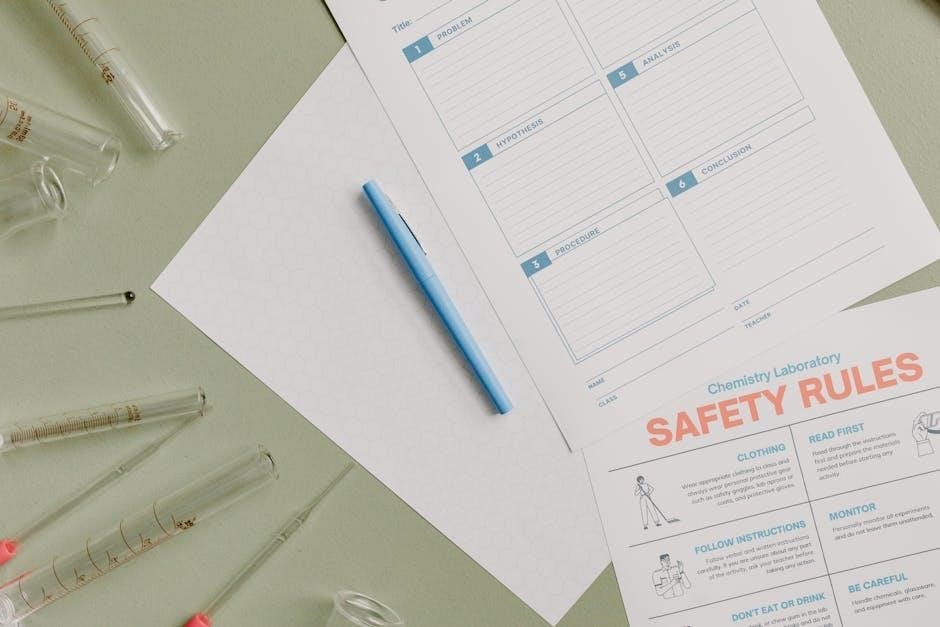
Half-life worksheets‚ frequently available as PDFs‚ are essential tools for students to grasp these concepts. They present scenarios involving different radioactive isotopes‚ like Barium-139 and Cobalt-60‚ challenging learners to calculate remaining amounts after specific time intervals. These exercises reinforce the understanding that radioactive decay follows first-order kinetics‚ meaning the decay rate is proportional to the amount of substance present.
Understanding the relationship between half-life and decay constant is vital. Moreover‚ these worksheets often incorporate practical applications‚ such as determining the age of artifacts using carbon-14 dating‚ showcasing the real-world relevance of this scientific principle. Practice with these problems builds proficiency in converting time units and applying the half-life formula effectively.

Defining Radioactivity
Radioactivity‚ a phenomenon discovered by Henri Becquerel‚ involves the spontaneous emission of particles – alpha‚ beta‚ and gamma – from unstable atomic nuclei. This instability arises from an imbalance in the neutron-to-proton ratio within the nucleus‚ prompting it to seek a more stable configuration through radioactive decay.
Half-life practice worksheets‚ often in PDF format‚ frequently begin by establishing this foundational understanding of radioactivity. They emphasize that this isn’t a chemical reaction altering the element‚ but a nuclear process transforming the isotope. These worksheets often ask students to define radioactivity and identify the types of radiation emitted.
Understanding the source of this instability is key. Nuclei with too many or too few neutrons are prone to decay. Worksheets also explore the concept of ionizing radiation and its potential biological effects. Practice identifying radioactive isotopes and their decay modes prepares students for more complex half-life calculations‚ building a solid base for further study in nuclear physics and chemistry.
What is Half-Life?
Half-life represents the time required for half of the radioactive atoms in a sample to undergo decay. It’s a constant value for each radioactive isotope‚ unaffected by external factors like temperature or pressure. Half-life practice worksheets‚ commonly available as PDFs‚ center around grasping this core concept.
These worksheets often present scenarios asking students to determine the remaining amount of a substance after one‚ two‚ or multiple half-lives. Understanding that it’s a statistical probability – we can’t predict when a specific atom will decay‚ only the decay rate of a large population – is crucial.
Practice problems frequently involve calculating the half-life given initial and final amounts‚ or determining the time elapsed given the number of half-lives. PDF resources emphasize visualizing this decay process‚ often using graphs or tables. Mastering half-life is fundamental to understanding radiometric dating and nuclear medicine applications‚ skills reinforced through dedicated worksheet exercises.
Calculating Remaining Atoms After One Half-Life
After one half-life‚ precisely half of the original radioactive atoms will have decayed into a different element. Half-life practice worksheet answers often begin with this fundamental calculation. If you start with‚ for example‚ 400 atoms‚ one half-life will leave you with 200.
Worksheets frequently present this as a simple division problem: initial amount / 2. PDF resources emphasize understanding that the type of atom changes‚ but the total number of atoms remains constant (decay products are included). This isn’t a loss of matter‚ but a transformation.
Practice problems may use grams instead of individual atoms‚ requiring conversion if necessary. Successfully solving these problems relies on recognizing the consistent 50% reduction after each half-life. Many worksheets include scenarios requiring students to identify the half-life from given data‚ then apply it to calculate the remaining amount after a single period.
Calculating Remaining Atoms After Multiple Half-Lives
Determining the remaining atoms after several half-lives builds upon the single half-life concept. Half-life practice worksheet answers demonstrate repeated division by two for each elapsed half-life. For instance‚ starting with 400 atoms‚ after two half-lives (two 50% reductions)‚ 100 atoms remain (400 -> 200 -> 100).
PDF worksheets often present problems requiring students to calculate the number of half-lives that have occurred within a given timeframe. This involves dividing the total time by the half-life duration. Then‚ apply the repeated division method.
Alternatively‚ a formula can be used: Remaining Amount = Initial Amount * (1/2)Number of Half-Lives. Many resources emphasize understanding this exponential decay pattern. Practice problems frequently involve converting time units (minutes to hours‚ years to days) before calculating the number of half-lives. Mastering this skill is crucial for accurate results.
Solving Half-Life Problems: A Step-by-Step Approach
Effectively tackling half-life problems‚ as presented in half-life practice worksheet answers PDF resources‚ requires a systematic approach. First‚ identify the known variables: initial amount‚ half-life duration‚ and elapsed time. Second‚ convert time units to match the half-life’s unit (e.g.‚ minutes‚ years).
Third‚ calculate the number of half-lives that have passed by dividing the elapsed time by the half-life duration. Fourth‚ utilize the formula: Remaining Amount = Initial Amount * (1/2)Number of Half-Lives. Alternatively‚ create a table tracking the remaining amount after each half-life.
Many worksheets emphasize showing your work for partial credit. Carefully consider the question’s request – is it asking for the remaining amount‚ the number of half-lives‚ or the initial amount? Practice with diverse problems builds confidence and reinforces understanding of exponential decay. Remember to double-check your calculations and units.
Setting Up a Half-Life Problem Table
A crucial technique for solving half-life problems‚ frequently demonstrated in half-life practice worksheet answers PDF guides‚ involves constructing a clear‚ organized table. Begin by creating columns for ‘Half-Life Number’‚ ‘Time Elapsed’‚ ‘Fraction Remaining’‚ and ‘Amount Remaining’.
Start with Half-Life Number 0‚ representing the initial state. Record the initial amount in the ‘Amount Remaining’ column. Subsequently‚ for each half-life‚ increment the ‘Half-Life Number’ and calculate the ‘Time Elapsed’ based on the given half-life duration. The ‘Fraction Remaining’ will always be 1/2 or 0.5.
Calculate the ‘Amount Remaining’ by multiplying the previous ‘Amount Remaining’ by 0.5. Continue this process until the desired elapsed time is reached or the amount remaining is negligible. This table provides a visual representation of exponential decay‚ simplifying complex calculations and aiding in understanding the concept. Many worksheets specifically request this tabular format for clarity and organization.
Converting Time Units for Half-Life Calculations
A common challenge in utilizing half-life practice worksheet answers PDF resources is ensuring consistent time units. Half-life is typically given in minutes‚ years‚ or seconds‚ while the problem might present the total time in a different unit. Accurate conversion is therefore essential for correct calculations.
For instance‚ if the half-life is in minutes and the total time is given in hours‚ convert hours to minutes (multiply by 60). Conversely‚ if the half-life is in years and the time is in days‚ convert days to years (divide by 365.25‚ accounting for leap years). Remember to maintain consistency throughout the calculation.
Worksheets often require expressing the final answer with appropriate units. Pay close attention to the units requested. Utilizing dimensional analysis – writing out the units alongside the numbers – can help prevent errors. Mastering these conversions is a fundamental skill demonstrated in successful completion of these practice problems.
Example Problem 1: Barium-139 Decay
Let’s tackle a typical problem found within a half-life practice worksheet answers PDF: Barium-139‚ with a half-life of 86 minutes‚ starts with a 17.8-gram sample. The question asks how much remains after 5 hours and 44 minutes. First‚ convert the total time to minutes: 5 hours * 60 minutes/hour + 44 minutes = 344 minutes.
Next‚ determine the number of half-lives that have elapsed: 344 minutes / 86 minutes/half-life = 4 half-lives. Now‚ calculate the remaining mass after each half-life. After one half-life: 17.8g / 2 = 8.9g. After two: 8.9g / 2 = 4.45g. After three: 4.45g / 2 = 2.225g. Finally‚ after four half-lives: 2.225g / 2 = 1.1125g.
Therefore‚ approximately 1.11 grams of Barium-139 will remain after 5 hours and 44 minutes. This example demonstrates the core process of applying the half-life concept‚ frequently assessed in these worksheets.
Example Problem 2: Cobalt-60 Decay
Consider another common problem type from a half-life practice worksheet answers PDF: Cobalt-60 has a half-life of 5.26 years. Suppose a sample initially contains 100 grams of Cobalt-60. The task is to determine how much remains after 15.78 years. Initially‚ calculate the number of half-lives that have passed: 15.78 years / 5.26 years/half-life = 3 half-lives.
Now‚ systematically reduce the sample mass with each half-life. After the first half-life: 100g / 2 = 50g. Following the second: 50g / 2 = 25g. And finally‚ after the third half-life: 25g / 2 = 12.5g. Therefore‚ after 15.78 years‚ 12.5 grams of Cobalt-60 will remain.
This problem highlights the importance of accurately calculating the number of half-lives. Many worksheets present variations of this‚ requiring students to demonstrate their understanding of exponential decay. Mastering these calculations is crucial for applications in fields like medicine and archaeology‚ often covered within the PDF resources.
Fermium-253 Half-Life Calculation
A typical question found within a half-life practice worksheet answers PDF involves Fermium-253‚ possessing a very short half-life of 0.334 seconds. Let’s explore a problem: If you begin with 8.0 grams of Fermium-253‚ how much remains after 1.336 seconds? First‚ determine the number of half-lives elapsed: 1.336 seconds / 0.334 seconds/half-life = 4 half-lives.

Now‚ apply the half-life reduction sequentially. After one half-life: 8.0g / 2 = 4.0g. Following the second: 4.0g / 2 = 2.0g. Then‚ after the third: 2.0g / 2 = 1.0g. Finally‚ after the fourth half-life: 1.0g / 2 = 0.5g. Thus‚ only 0.5 grams of Fermium-253 will remain after 1.336 seconds.
These calculations emphasize the rapid decay of isotopes with short half-lives. Worksheets often use such examples to test understanding of the exponential nature of radioactive decay. Successfully solving these problems requires careful attention to units and accurate division‚ skills reinforced by practice using PDF resources.
Determining Complete Decay Time (10 Half-Lives Rule)
A common principle encountered in half-life practice worksheet answers PDF materials states that a radioactive sample is considered practically decayed after approximately 10 half-lives. This isn’t absolute zero‚ but represents a negligible amount remaining – less than 0.1% of the original sample. Let’s illustrate with an example.
Suppose Polonium-210‚ with a half-life of 138.4 days‚ is initially present in a 500-gram quantity. To determine the time needed for near-complete decay‚ multiply the half-life by 10: 138.4 days/half-life * 10 half-lives = 1384 days. Therefore‚ after roughly 1384 days‚ the Polonium-210 sample will be considered essentially gone;
Worksheets frequently pose questions requiring this calculation‚ testing the student’s grasp of the 10 half-life rule as a practical approximation. Understanding this rule simplifies estimations without needing precise fractional calculations. PDF resources often include problems specifically designed to reinforce this concept‚ aiding in quick assessments of decay timelines.
Using the Half-Life Gizmo for Simulation
Many half-life practice worksheet answers PDF resources recommend utilizing the “Half-Life Gizmo” – an interactive online simulation. This tool allows students to visually explore radioactive decay‚ manipulating factors like initial sample size and observing the resulting decay curves. The Gizmo provides a dynamic learning experience‚ complementing traditional worksheet problems.
Within the Gizmo‚ users can select different isotopes and track the number of remaining atoms over time. This hands-on approach reinforces the concept of exponential decay and the relationship between half-life and decay rate. Worksheets often include questions directly related to Gizmo observations‚ requiring students to interpret simulated data.
The Gizmo’s interactive nature helps solidify understanding‚ particularly for students who struggle with abstract mathematical calculations. PDF guides accompanying the Gizmo often provide specific instructions and pre-designed activities‚ ensuring effective integration with classroom learning and practice problems. It’s a valuable supplement for mastering half-life concepts.
Half-Life Practice Problems: Common Types

Half-life practice worksheet answers PDF materials consistently feature several recurring problem types. These commonly include calculating the remaining amount of a radioactive substance after a given time‚ determining the half-life of an isotope from decay data‚ and converting between different time units (minutes‚ hours‚ years). Many worksheets also present scenarios requiring students to calculate the initial amount of a substance given its remaining quantity.
Another frequent type involves determining the time required for a sample to decay to a specific percentage of its original amount. These problems often necessitate the use of logarithms. Furthermore‚ worksheets frequently incorporate real-world applications‚ such as carbon-14 dating or medical isotope usage‚ adding context to the calculations.
Successfully solving these problems requires a firm grasp of the half-life formula and the ability to apply it to various scenarios. PDF resources often provide step-by-step solutions and explanations for these common problem types‚ aiding students in building confidence and proficiency.

Real-World Applications of Half-Life Calculations
Understanding half-life extends far beyond theoretical exercises found in half-life practice worksheet answers PDF documents. Its principles are fundamental to numerous real-world applications across diverse fields. Carbon-14 dating‚ a cornerstone of archaeology and paleontology‚ relies on the known half-life of carbon-14 to determine the age of ancient artifacts and organic materials.
In medicine‚ radioactive isotopes with short half-lives are used for diagnostic imaging and cancer treatment. The precise half-life ensures effective treatment while minimizing long-term radiation exposure. Nuclear power also utilizes half-life concepts to manage radioactive waste and assess reactor safety.
Environmental science employs half-life calculations to track the decay of pollutants and assess their impact on ecosystems. Furthermore‚ geological dating methods utilize the decay of various isotopes to establish the age of rocks and the Earth itself. These applications demonstrate the practical significance of mastering half-life concepts.
Resources for Half-Life Practice Worksheets (PDF)
Numerous online platforms offer readily accessible half-life practice worksheet answers PDF resources for students and educators. Websites like ScienceSpot‚ Chemfiesta‚ and various school district pages provide downloadable worksheets covering a range of difficulty levels. These resources typically include problems focused on calculating remaining amounts‚ determining half-life values‚ and applying the concept to real-world scenarios.
Khan Academy offers comprehensive lessons and practice exercises on radioactive decay‚ complementing worksheet practice. Additionally‚ educational publishers such as Pearson and McGraw-Hill often include half-life worksheets in their chemistry and physics textbooks‚ frequently available as PDF supplements. Exploring Teachers Pay Teachers can also yield a variety of created worksheets.

The Half-Life Gizmo‚ mentioned in several resources‚ provides an interactive simulation that reinforces understanding. Remember to search specifically for “half-life worksheet PDF” to filter results effectively and find materials aligned with your curriculum needs.
Addressing Common Errors in Half-Life Calculations
A frequent mistake when solving half-life practice worksheet answers PDF problems involves incorrect time unit conversions. Students often forget to convert hours to minutes or years to days before dividing by the half-life period. Another common error is misinterpreting the concept of ‘half-life’ itself – it’s the time for half the substance to decay‚ not the time for the entire sample to disappear.

Careless arithmetic‚ particularly with exponents‚ also leads to inaccuracies. Remember that each half-life reduces the amount by a factor of 1/2. Failing to establish a clear table to track time‚ number of half-lives‚ and remaining amounts can contribute to confusion. Students should also avoid rounding intermediate calculations‚ as this can propagate errors.

Finally‚ misunderstanding the 10 half-life rule – considering a substance ‘completely decayed’ after this period – can cause issues. Always double-check units and ensure a logical progression through the calculation steps to minimize errors.